OLYMPIA – Sheriffs from across Washington state testified against a bill that would introduce new eligibility criteria for police chiefs, marshals, and sheriffs during a contentious public hearing Jan. 15.
One sheriff’s testimony was considered so inappropriate that the Washington Association of Sheriffs and Police Chiefs (WASPC) is considering expelling him. And the prime sponsor of the bill said the remarks show why new requirements are needed.
The sheriffs claimed Senate Bill 5974 would wrongly give the Criminal Justice Training Commission (CJTC), an unelected body, the power to remove an elected sheriff from office if their certification as a law enforcement officer is revoked.
“This legislation … is an offense to me as a citizen and a voter in the state of Washington,” John Nowels, Spokane County sheriff and president of WASPC, said. “This bill essentially and functionally removes the voice of voters in the state of Washington.”
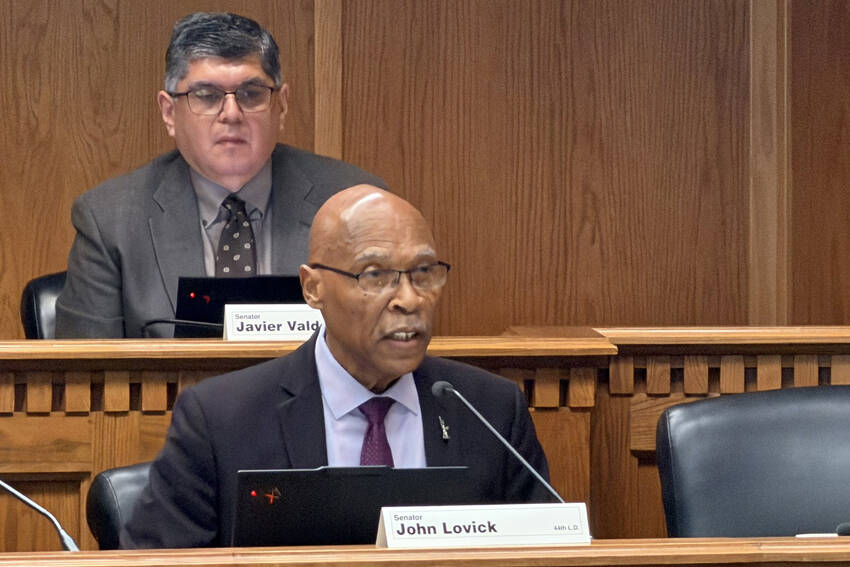
But, for the prime sponsor of the bill, Sen. John Lovick, D-Mill Creek, this policy is a way to modernize outdated standards and improve relationships between the public and law enforcement.
“The ultimate impact we hope to make with the bill is better community relations and total accountability,” Lovick said.
Under current law, police chiefs and marshals are subject to several eligibility criteria. This includes having a high school diploma, having no gross misdemeanor convictions within five years of application, and having at least two years of regular, full-time commissioned law enforcement employment.
The current eligibility requirement for sheriffs, who are the only elected law enforcement leaders in Washington, is to obtain certification from the CJTC within 12 months of assuming office.
The proposed bill would add new eligibility requirements for chiefs and marshals, such as obtaining certification within nine months of taking office, passing a new background investigation process, and having five years of regular, uninterrupted, full-time law enforcement employment.
The legislation would also make sheriffs subject to both the current and added eligibility requirements chiefs and marshals are subject to.
Lovick, who served as a state trooper for 31 years and the sheriff of Snohomish County for about six years, said his proposed bill puts him at odds with many current sheriffs. While Lovick said he is fine with people disagreeing over the measure, he emphasized that any disagreements should remain respectful.
Some were not, he said.
In particular, Lovick said that Pierce County Sheriff Keith Swank’s comments during his testimony could be seen as threatening to legislators.
“I don’t recognize your authority to impose controls over me, and when you try to remove me from office, thousands of Pierce County residents will surround the County-City Building in downtown Tacoma and will not allow that to happen,” Swank said. “I hope it doesn’t come to that, but I and they are prepared. Are you prepared?”
A joint statement released Thursday evening by Nowels and WASPC Executive Director Steven Strachan, a former King County sheriff, referred to Swank’s comments as “inflammatory” and not representative of the views or approach of WASPC. The statement also said WASPC intends to initiate proceedings to consider expulsion of Swank from the organization.
“[Swank] is the top law enforcement official in that county, and it’s unfortunate that he had to say what he said and make some people I know … [feel] threatened,” Lovick said.
SB 5974 is currently scheduled for an executive session Jan. 22 in the Senate Committee on Law and Justice. The policies proposed in SB 5974 were previously introduced in House Bill 1399 and its companion bill Senate Bill 5364 during last year’s legislative session.
While neither bill passed, Lovick said the amount of work and energy put into crafting the current bill makes him believe it will reach the governor’s desk this session.
“I’m confident this bill is going to pass,” Lovick said. “The person who probably said the most that it should happen was Keith Swank. He basically showed the reason we need this kind of legislation.”
The Washington State Journal is a nonprofit news website operated by the WNPA Foundation. To learn more, go to wastatejournal.org.