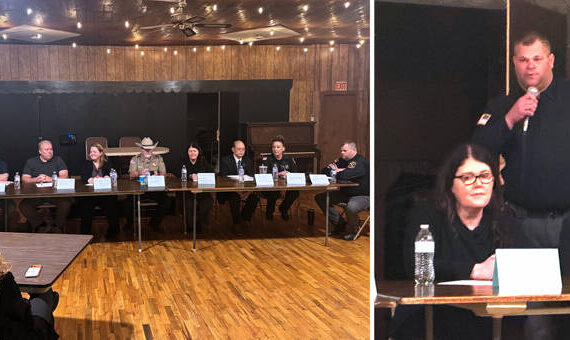

OROVILLE – A meeting held last Thursday to discuss the rash of property crimes, especially by juveniles, taking place in the area was well attended by concerned citizens and public officials.
In addition to Okanogan County Commissioner Jon Neal and Oroville Mayor Ed Naillon, Okanogan County Prosecutor Albert Lin, Deputy Prosecutor Rochelle Lawson and Administrative Assistant Teagan Levine; Okanogan County Sheriff Paul Budrow and Deputy Jodie Barcus and Oroville Police Chief Gary Hirst were on hand at the Oroville Grange Hall to listen to those with concerns and answer questions about the criminal justice system, especially where it concerned property crimes committed by juveniles. Also on the panel was Quinn Lontz with Okanogan Behavioral Healthcare.
“We are here to answer what happens in the process and where to go when something does happen, rather than just run around and try to figure it out,” said Commissioner Neal. “Hopefully, we will get the staff to lay it out for you, so you know the process and eliminate a lot of the confusion. A lot of things get said and half of that is not factual. And this process will hopefully make it a lot clearer for everybody, including me.”
Oroville has seen an uptick in juvenile property crime and there is a growing frustration that when juveniles are found to be guilty of crimes it isn’t long before they are back in town and found to be committing more crimes. Several business owners expressed concern over having suffered repeated property damage that ends up costing them money to repair, which is eating into very thin bottom lines.
Lawson said that the way they were going to structure the meeting is to give a perspective of how things work through the system.
”So, you call 911 to report a juvenile committing a crime, it is sent to the Okanogan County dispatch,” said Assistant Prosecutor Lawson, adding that the dispatcher determines whether law enforcement will be dispatched depending on the situation, whether criminal or civil.
“Law enforcement are to keep the peace and enforce criminal law. If it is a civil dispute that has to be handled in civil court,” she said.
Lawson said if it is a mandatory arrest, the suspect will be booked into the Okanogan County Jail.
Prosecuting Attorney Lin, said this regards adult cases, cases like domestic violence or felonies.
“My office determines what charges are to be filed,” he said. “The property crimes are more likely to be released on bail.”
He said that the decision to keep the suspect in jail or to release them is based on state laws and the more violent offenders are usually the ones that remain in jail awaiting trial.
Neal asked if they could start over and explain the difference between how juvenile cases are handled compared to adults.
“So with juveniles, we get the call as we explained earlier, law enforcement goes in and investigates it, figures out if we have a crime and what’s going on. There are a lot of parts to it we have to gather a lot more evidence before we can either make an arrest or send it to prosecutors to review the case. Most of the time, it has to be a pretty violent or damaging incident that took place as far as booking them into jail. Trespassing or minor damage, stuff like that, when we call, we are denied booking them into the juvenile,” said Chief Hirst.
Lawson further explained that with juveniles, you need probable cause without talking to the suspect.
“All the evidence gathering is very crucial in juvenile cases because you can’t talk to the juvenile as law enforcement. It has been like that for a while, unfortunately,” she said. “If you have kids fighting on the school grounds and one of them is beaten up pretty bad, five or ten years ago we could ask what happened. Then you might find out these kids beat up pretty bad because he pulled a knife on the other kid. Those are the things we would get if we could talk to them about it but we can’t.”
Most of the panel expressed a concern that current state laws tie their hands in such a way that juveniles who should face stiffer penalties for crimes. There seemed to be a general feeling from the panel that their hands are tied.
Prosecutor Lin and most of the others said things like cameras can be helpful as evidence. Lin also said promptly reporting crimes to authorities is essential in helping to prosecute these cases.
In addition, several people are organizing a neighborhood watch to aid law enforcement as potential witnesses to crimes. Similar watches have been shown to reduce juvenile crimes elsewhere.