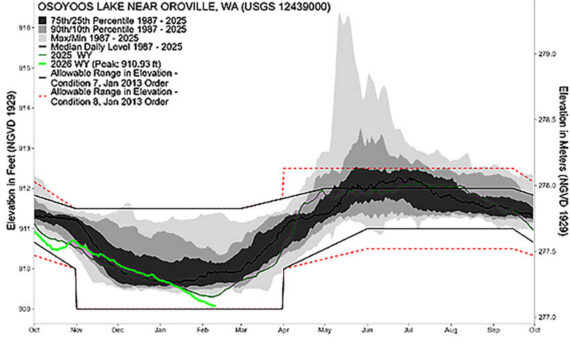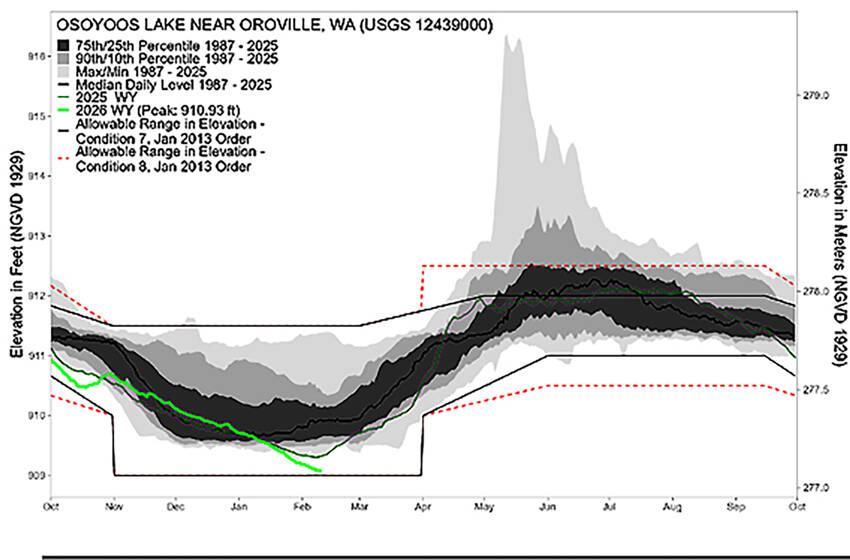
OROVILLE/OSOYOOS – The water levels in Osoyoos Lake have reached historic lows due to dry conditions within the Okanagan basin. The lake level is currently 909.12 ft, which is the lowest on record.
Water levels are likely to remain low until more water enters the Okanagan River system. Osoyoos Lake operators are monitoring conditions closely and plan to maintain the current lake level at, or near, 909.1 feet, according to the International Joint Commission (IJC), which has representatives from the U.S. and Canada. This level complies with the IJC’s Orders for Osoyoos Lake, which establish allowable lake levels
Below Normal Snowpack
This has been a dry winter in the Okanagan Basin, with below-normal snow accumulation. Snowpack in the Okanagan Basin is at 67 percent of normal, according to British Columbia’s Feb. 1 Snow Survey and Water Supply Bulletin. Much of the snowpack accumulated in December and early January before a period of warmer and drier weather led to snowmelt at lower elevations.
“As a result, flows in the Okanagan River are lower than normal and models forecast a continued risk of reduced seasonal runoff. Upstream of Osoyoos Lake, Okanagan Lake is at a lower-than-normal water level. Okanagan Lake serves as a major water storage location, and operators are actively balancing the need to hold water for summer use while serving downstream needs,” says the Survey and Water Supply Bulletin.”
Looking Ahead
Residents should plan for lake levels to remain low for the foreseeable future. The Osoyoos Lake operator is maintaining lake levels at, or near 909.1 feet, until more water begins entering the lake. Historically, this occurs in late February; however, given this year’s low snowpack, more water may not be available until later in the spring. The spring freshet typically occurs in April, when snowmelt and rainfall lead to increased runoff in the Okanagan River.
The International Joint Commission’s Osoyoos Lake Board of Control will continue to monitor hydrologic conditions and communicate with lake operators and the public.
The Oroville-Tonasket Irrigation District (OTID) operates Zosel Dam on the Okanogan River, controlling Osoyoos Lake levels in Washington state under contract with the state Department of Ecology. Zosel Dam is subject to international water-sharing agreements governed by the International Joint Commission.
For real-time updates on Osoyoos Lake levels, visit the U.S. Geological Survey web page for Osoyoos Lake.