Article by Kate Miller
OLT Executive Director
A rare peatland in the Okanogan Highlands of North Central Washington is the focus of a $1.5 million fundraising campaign being launched in March 2026 by your very own Okanogan Land Trust.
Spearheaded by OLT and supported by a coalition of local organizations and community members, the For the Fen campaign seeks to acquire, protect, and restore the 260-acre wetland together with the surrounding forested uplands, 745 acres in all. This is a unique and special conservation opportunity, both for its ecological significance and its iconic place within our landscape. Many members of the highlands community and local naturalists have been waiting and watching for decades for the chance to protect it — and now we can.
Not a Meadow or a Bog, But a Fen
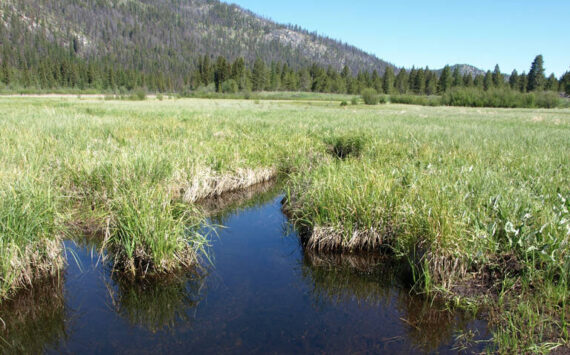
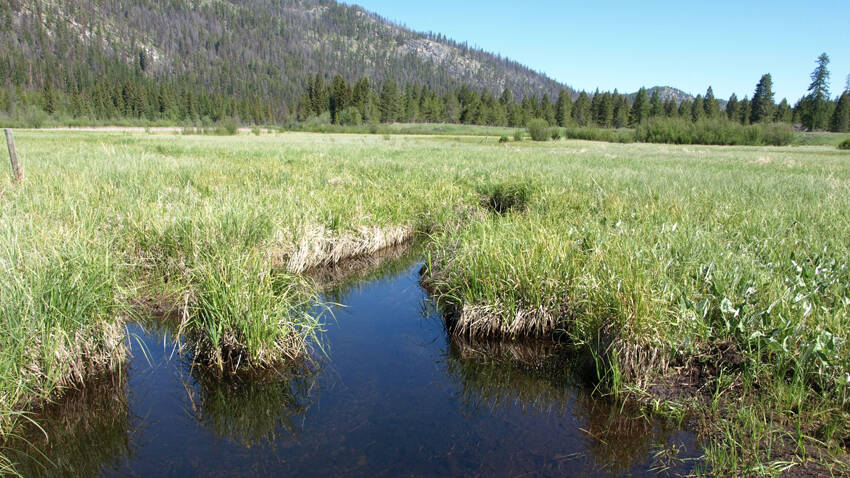
Known locally as Bonaparte Meadows, or simply “the bog,” the property at the center of this effort lies below local landmark Mount Bonaparte and immediately downstream of Bonaparte Lake, a popular area for fishing and recreation. Bonaparte Creek flows through the wetland, where it is augmented by groundwater before converging with Toroda Creek and flowing down to the Okanogan River. The influx of groundwater and the movement of water through the site makes this wetland a fen as opposed to a bog, which is primarily fed by rain or runoff. And it is not just any fen; the limestone substrate through which the water filters makes it a calcareous fen, one of the rarest wetland types in the United States.
The rarity of the wetland type and its critical support for diversity of wildlife in Okanogan County are some of the chief reasons why OLT and its partners hope to protect Bonaparte Meadows. The unique soil and water chemistry gives rise to equally unique plants and plant associations – species and combinations of species, including rare sedges, willows, and arrowgrass, among others. The presence of such a large and thriving wetland also attracts amphibians such as the listed and priority species Columbia spotted frog and a tremendous variety of resident and migratory birds. Many of the distinctive large mammal species – from mule deer and moose to Canada lynx, wolves, and badgers – live on or move seasonally through the property between large areas of public land on either side.
Okanogan County is a hotspot for calcareous fens in Washington State, including five sites listed as Wetlands of High Conservation Value statewide. Home to several rare plant species and a critically imperiled plant association, Bonaparte Meadows is a Category 1 wetland that represents a significant component of Washington’s natural heritage and is a high priority for protection.
Wetlands such as Bonaparte Meadows are essential to the functioning of their watershed due to their water storage functions. In this arid landscape, tucked in the rain shadow of the North Cascades, this ability to capture and store water when it’s available and slowly release it during the drier months is crucial to the future of tributary streams like Bonaparte Creek and the Okanogan River itself. With average snowpack declining and more winter precipitation falling as rain instead of snow, wetlands will play an even more important role in the system going forward.
In addition to storing water, peatlands also store carbon. Globally, according to the UN Environmental Program, peatlands store twice as much carbon than all the world’s forests combined. Peat forms when plant matter breaks down very slowly in permanently water-logged conditions. This process of plant growth and decay sequesters the carbon that plants have drawn from the atmosphere, storing it in peat soils, helping to mitigate climate change. Conversely, drained and degraded peatlands release carbon back into the atmosphere, contributing to rising average temperatures. For this reason, the International Union for the Conservation of Nature recommends that countries embrace the protection, rewetting, and restoration of peatlands as key parts of their climate strategies.
Acting Now for the Long Term
Indeed, the urgency to protect Bonaparte Meadows is fueled in part by the opportunity to restore parts of the wetland that have been impacted by a history of peat extraction going back to the 1950s (peat matter is prized as a gardening medium). To facilitate peat extraction, the stream channel was straightened and dredged, lowering that has lowered the water table across the site. Rebuilding all the layers of peat that have been lost will take thousands of years, but the time to begin is today. The good news is that by raising the water table in the wetland alone will result in rapid restoration of habitat conditions and water storage capacity, and will reset conditions for peat to begin reforming.
In the winter of 2023, OLT was one of several organizations receiving calls from concerned neighbors, highlands residents, and amateur and professional naturalists.
“Do you know about this, and what can we do?” Kate Miller recalls being asked by Anne McDonaugh, who lives just south of Bonaparte Meadows.
McDonaugh and her wife, Cheryl McGinley, knew Jack Jones, the late owner of the property, and were among the first to hear about his plans to sell after over 50 years. Around the same time, the Okanogan Conservation District, the Fish and Wildlife Department of the Confederated Tribes of the Colville Reservation, the Okanogan Highlands Alliance and Trout Unlimited became involved. For a year and a half, the loose coalition of individuals and organizations sought a solution, with Julie Vanderwal, a Certified Ecological Restoration Practitioner and owner of Sparrow Song Consulting based in Twisp, playing an essential coordinating role.
After a few dead ends, it became clear that a strategy combining grant funding with private fundraising was the way to protect property within the timeline the owners – by now the family of Jonesw, who passed away in early 2025 – had given them.
Before he passed, he bequeathed one indispensable gift to the effort to protect Bonaparte Meadows: he told his children that he hoped the property would remain intact. This led the family to enter into an option agreement with Okanogan Land Trust, giving them until the end of July 2026 to find a way to purchase the land. OLT stepped into the role of presumptive buyer and holder of the land. From there, assisted by its partners, the land trust has moved quickly to finalize its acquisition strategy and marshal community support, and is now launching the public phase of the For the Fen capital campaign to protect this rare, sensitive, and damaged but resilient wetland for perpetuity.
To learn more about the reasons to protect Bonaparte Meadows or lend your support, visit okanoganlandtrust.org/bonaparte. To volunteer your time or expertise or to discuss a major gift to the campaign, contact kate@okanoganlandtrust.org.