By Annika Hauer
WNPA News Service
OLYMPIA — Senators passed a bill out of committee that would raise the maximum pay for school board members from $50 to $100 per working day, reimburse childcare costs during meetings and require finance training.
A 2023 study by the Washington State Department of Commerce found that 68 percent of school board members received no compensation for their work. The proposed bills—SB 5860 and companion HB 2366—do not require that the directors are compensated but would raise the maximum that they could be paid.
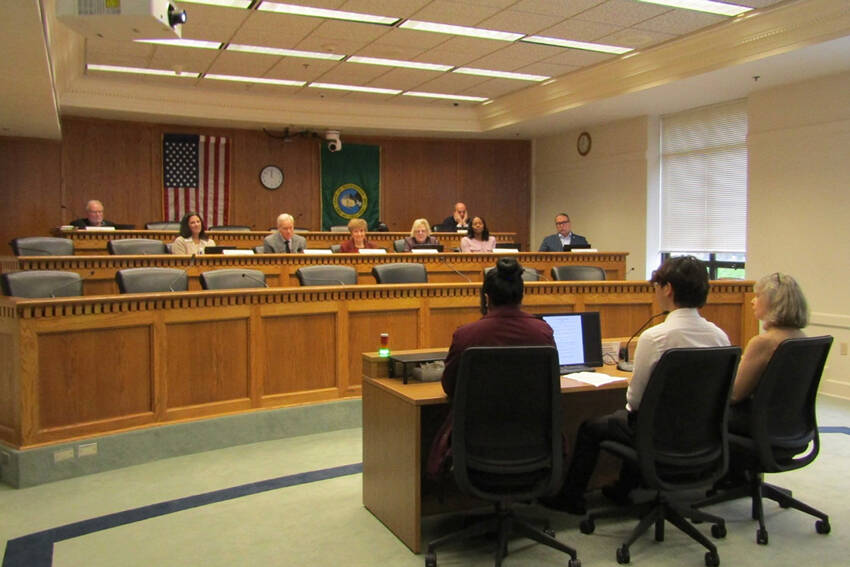
SB 5860 passed the Senate Early Learning & K-12 Education committee and has been sent to the Ways & Means committee, where its funding will be discussed. The last day for the bill to advance out of Ways & Means is Feb. 9.
It’s important for people with various backgrounds to be in roles that serve their communities, Sen. Adrian Cortes, D-Battle Ground, said upon introducing the bill to the committee.
Compensation for school board members has not changed in 40 years, since a law passed in 1987 stated they could be paid. A bill to allow more pay did not make it out of committee in 2024.
“Serving on a school board requires significant time, preparation, and responsibility,” Tyler Muench, who testified Jan. 14 on behalf of the Office of the Superintendent of Public Instruction, said. “When the role is unpaid, participation is effectively limited to those who can afford to volunteer—often retirees, higher-income professionals, or individuals with flexible schedules.
“This excludes working parents, hourly wage earners, caregivers, and younger residents, even though they are deeply invested in public education and bring essential lived experience.”
The same 2023 study found that 13 percent of school board members in Washington state had a salary below $60,000. Also, 10 percent identified as people of color, and 76 percent of those served in two of the state’s 39 counties, King and Pierce.
As the bill reads, funding for compensation of school board members may only be provided from excess local levy funds and not paid by the state.
The Washington State School Directors’ Association (WSSDA) provides school board members with professional development and a network of other school board members.
“[WSSDA members] have shared concern that any compensation increase funded by its district budgets would divert resources from students and classrooms,” said Heather Curl, who testified Jan. 14 on behalf of WSSDA, whose members are split on the bill. “There are also districts across our state that cannot access levy dollars and therefore wouldn’t be able to access compensation.”
Compensation for childcare is under a different umbrella of reimbursement—if this bill passes, child care costs would be added to the list of “actual expenses” that a school board member pays to show up to meetings.
The bill also makes a requirement for school board members to complete finance training. These trainings are now optional and cost a $90-$100 fee per member. As the bill reads, the state would cover this cost.
“School boards oversee multi-million dollar budgets funded by taxpayers,” Muench said. “Members routinely vote on contracts, staffing levels, debt, audits and long-term financial commitments that directly affect classrooms and community finances. Making these decisions without a baseline understanding of public finance exposes districts to risk.”
The Washington State Journal is a nonprofit news website operated by the WNPA Foundation. To learn more, go to wastatejournal.org.