Following in footsteps of the Fur Brigade
Published 11:03 pm Thursday, September 22, 2011
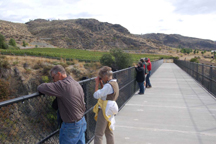
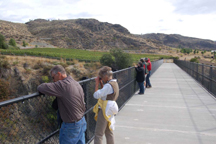
Those on the field trip last Sunday, Sept. 18 stop to take in the view of the Similkameen River on the refurbished steel girder bridge that is now part of the Similkameen Connector Trail. In addition to the river, those crossing the bridge can take in vie
NORTH COUNTY – Several people took advantage of the chance to follow in the footsteps of the fur brigades that trailed through the American and Canadian Okanogan/Okanogan Valley some 200 years ago, listening to lectures and participating in field trips to McLaughlin Canyon and the Similkameen River Trail.
The 200th anniversary celebration of the fur trade included historical lectures about the nearly half-century of the Fur Brigade Trail from 1811-1860. Ken Favrholdt, historian and Curator of the Osoyoos Museum and Randy Manuel, President of the Okanagan (B.C.) Historical Society brought their expertise, experience and historic maps to talk about the actual 1,200 mile long trail, as well as local historical details. Following the talk in Tonasket on Friday, 14 people went on the tour at McLaughlin Canyon south of Tonasket.
At Oroville on Saturday, Sept. 17, Favrholt and Manuel spoke about the ancient Osoyoos Lake crossroads and the major fur brigade encampment at the “Okanogan Forks of the Okanogan and Similkameen Rivers. The presentation was hosted at the Depot Museum by the Okanogan Borderlands Historical Society.
“The American’s occupation at Fort Okanogan, the native use of horses and trade goods, the ethnic groups including Indian, French-Canadian, Scottish, Hawaiian Kanaka as well as Father DeSmet at the ‘Plain of Prayer’ near Hiram Smiths later orchards, were all reviewed,” said Kay Sibley, Director of the Okanogan Borderlands Historical Society. “Major trail changes after the 1846 Boundary settlement, the removal of Hudson Bay Company to Fort Similkameen (Keremeos) were noted as well.”
Manuel and Favholdt had researched and are very well versed in the pre-Civil War saga of the Okanogan-Okanagan region, according to Sibley, who added, a lively historical discussion after the program was a highlight as well.
About eight were on the Similkameen Trail tour the next day on Sunday, Sept. 18.
The series is sponsored by the Okanogan County Historical Society and the Okanagan (BC) Historical Society. The Fur Brigades lectures will move to Canada and run into October, according Ted Murray, Outdoor Recreation Coordinator for Okanogan County.
For more information email: museum1@vip.net or call (250) 495-2582.
About Gary DeVon

Gary DeVon is the managing editor of the Okanogan Valley Gazette-Tribune and celebrated his 25th year at the newspaper in August 2012. He graduated from Gonzaga University with a degree in Communications - Print Journalism, with an emphasis in photojournalism. He is a proud alumnus of Oroville High School. His family first settled in Okanogan County in the late 1800s. His parents are Judy DeVon and the late Larry DeVon and he has two younger brothers - Dante and Michael. Many family members still call Oroville home. He has a grown daughter, Segornae Douglas and a young granddaughter, Erin.
 More by Gary